Configuration
Technical Insights
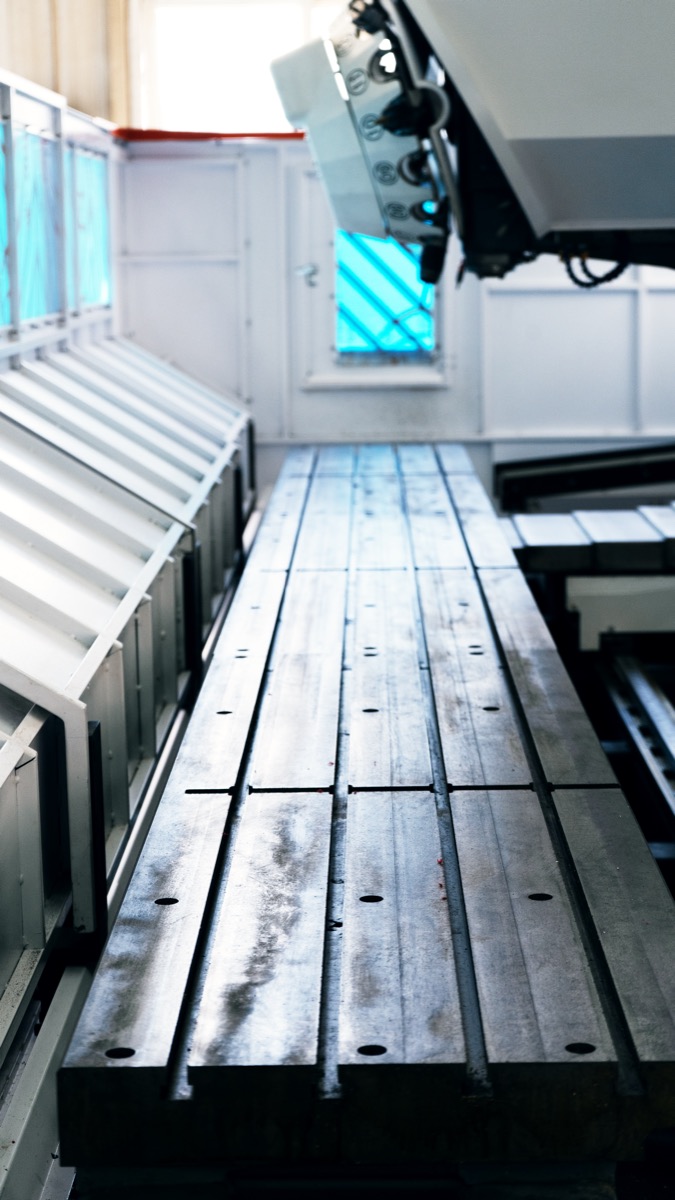
Spindle taper is the dividing line in machine positioning. The difference between BT30 and BT40 goes far beyond taper size: it changes toolholder rigidity, clamping force, bearing specification and overall load capacity, and ultimately determines which class of material removal the machine is built for.
BT30: the cost-effective choice for general work
A BT30 spindle with servo drive reaches high speeds and changes tools quickly, suiting aluminium profiles, aluminium-wood composites and steel parts with moderate removal. For curtain wall profiles, PV frames and battery trays — parts dominated by milling and drilling — a BT30 configuration usually gives the best balance between cycle time and cost.
BT40: high removal rates and heavy workpieces
The BT40 taper has a larger contact surface and stronger clamping force, sustaining higher cutting torque and axial load. When machining thick-walled steel profiles, large-section structures, or removing a lot of material in a single setup, the rigidity advantage of BT40 shows up directly as more consistent dimensions and longer tool life.
Decide by removal rate, not workpiece size
- Mainly milling, drilling and tapping with moderate removal → BT30 is enough
- Thick-walled steel, large sections, continuous heavy cutting → consider BT40
- Heavy workpiece but light cutting → look at table load capacity, not taper
- Both steel and aluminium → select for the steel case, slow down for aluminium
BT30 vs BT40, item by item (with our actual machine configurations)
| Item | BT30 | BT40 |
|---|---|---|
| Taper | 7/24 taper No.30 | 7/24 taper No.40 |
| Holder rigidity | Medium — suits moderate cutting force | High — suits heavy cutting and long overhang |
| Spindle power (example) | 5.5 kW (WGTA-4500) | 7.5 – 15 kW (WGTB-6500 / WGTC-3027) |
| Max speed | 12000 rpm | 12000 – 16000 rpm |
| Rated torque (example) | 45 N·m (WGTA-4500) | 52.5 N·m (WGTB-6500) |
| Typical tool weight limit | About 3 kg | About 7 – 8 kg |
| Typical tool diameter | Ø60 mm | Ø80 – Ø120 mm |
| Materials and duty | Aluminium, copper, U-PVC; thin walls, moderate depth | Steel, thick-wall profiles, large sections, continuous heavy duty |
| Models in our range | WGTA-4500 | WGTB-6500 / WGTC3016 / WGTC-3027 |
Frequently asked questions
- Can a BT30 machine cut steel?
- Yes. A BT30 spindle in the 5.5 kW class, with the right tooling and cutting data, handles drilling, tapping and moderate-depth milling of small and medium steel sections reliably. The limit shows up with large sections, continuous heavy cutting or long overhang — insufficient rigidity then appears as chatter, dimensional drift and shorter tool life.
- Does choosing BT40 mean giving up spindle speed?
- No. BT40 machines also reach 12000–16000 rpm, which is fine for aluminium. The trade-off is greater rotational inertia in the spindle and holder, slightly slower acceleration and tool changes, and a higher machine price.
- We may take on steel later — will we regret BT30 now?
- It depends on how much steel and how much material removal. If steel is occasional and cuts are shallow, BT30 is enough. If steel is likely to exceed about 30% of the work with heavy removal, go straight to BT40 — the taper is structural and cannot be upgraded later.
- Does a larger taper mean higher accuracy?
- Not directly. Accuracy comes from positioning accuracy, repeatability, and the manufacturing and assembly quality of spindle and holders. The advantage of BT40 is rigidity and chatter resistance, not the accuracy figure itself.
One caution: a large workpiece does not automatically require BT40. What actually determines the taper is material removal per unit time and the resulting cutting force. If the part is large but the cutting is light, look at table load capacity and fixturing first rather than upgrading the taper.